
AI is shaping the future of education, bringing opportunities but also risks about its ethical and sustainable usage. Here’s how your Student Officers have been raising the voice of Exeter students on campus and beyond...
In February 2026, Exeter Student’s Guild released it’s Artificial Intelligence Report in which students reported the following:
· The most common reasons for using AI were because it was a fast and easy option (31%), using it for academic purposes (28%) and generally feeling at a potential disadvantage in not using it.
· A majority of students(60%) reported that AI skills are an important part of their education, compared to 24% who do not.
· 33% of students would not change anything about how AI is currently used on their course, but 13% of students reported needing clearer guidelines and 6% of students feeling that it should either be banned or made harder to use.
· Students that choose not to use AI cite reasons such as the environmental impacts (58%), preferring self-reliance (20%), and ethical concerns (11%).
· 37% of students reported worrying fairly to very often about their work being flagged or penalised due to AI use
The responses you give us are essential for informing University staff of where they are moving in the right direction, but also where they risk leaving students feeling behind the times and unable to engage critically with their course. As such, Francis held our first student’s assembly on “How AI is intersecting with Education experience”, offering space for University policymakers and students to have a dialogue, and ultimately inform the University strategy. Whilst most students were interested, one student had not used AI, and when offered a hypothetical AI tool by the University, he said he wouldn’t use it as it doesn’t interest him. Other student concerns were data privacy, deepfakes and transparency of staff use. This was a key point raised by students, feeling that transparency from staff around their AI usage within modules was essential, particularly in marking. This had led to a lack of clarity when it came to ethical usage when working.
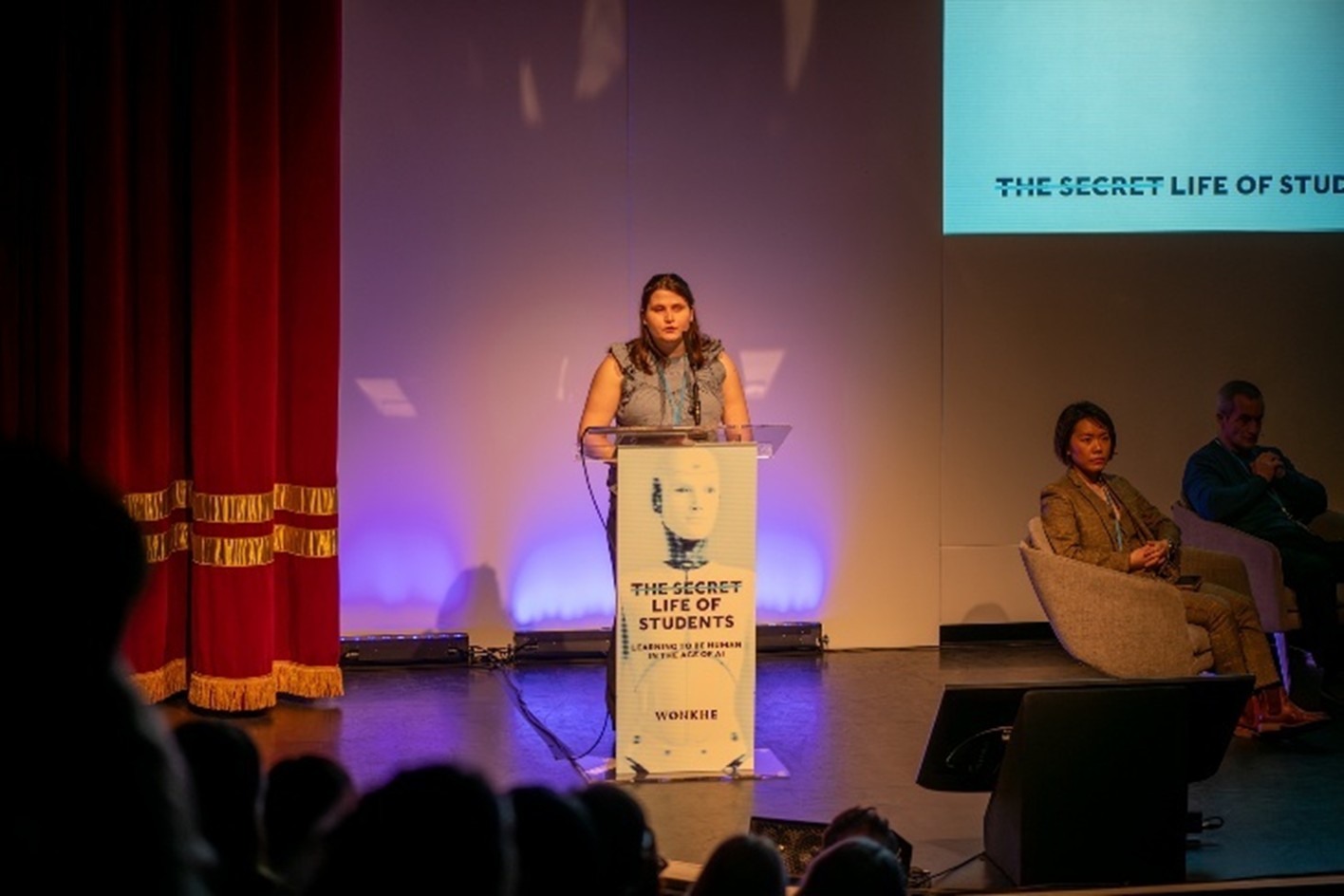
Gemma was invited to deliver a speech on creative students fear of AI as well as disciplinary panels and employability at the Wonkhe conference on AI for higher education, ‘The Secret Lives of Students’, Francis was in attendance.
“I am concerned that AI is going to cause people to devalue human creativity but, I haven’t knowingly seen AI out-compete human creativity. Not yet at least…”
“We are gaining nothing by being divided on how students should be using AI and a lack of clear guidance and fear mongering is preventing students from being able to freely engage in the discourse.”-Gemma’s speech. More at: Creative students are either afraid of being caught or afraid of being left behind Wonkhe
Other student stories highlighted the importance that remembering ‘behind every disciplinary on AI, there is a student’, particularly for international students and viva’s impacting their visa status, and how AI can be used to ‘level the playing field’ for disabled students.
The conference presented some panel discussions on the topics of employability and assessments. Some interesting discussions were had on productivity, retaining critical thinking skills and if assessments are currently accessible. There was acknowledgement that AI is a ‘scary topic’ but we need to stop letting that fear from stopping us from planning ahead. “It’s not AI that will replace the students but the students who use AI will replace the students who don’t”- discussion on panel.
Some recommendations made throughout the day were AI literacy in the curriculum, teaching staff how to teach students on it, defining where the line is on a grey area and misconduct, case specific examples to help students with employability searches - rather than just a blanket, ‘chat gpt evaluate this for me.’
The University currently offers AI upskilling sessions through the Library team and there is an optional AI minor being offered to first years as part of the Curriculum for Change future skills pathway.
Francis and Gemma (Education Officer and Societies and Employability Officer)